A brief review on the use of chelation agents in sol-gel synthesis with emphasis on β-diketones and β-ketoesters / S. Kurajica.
Sažetak
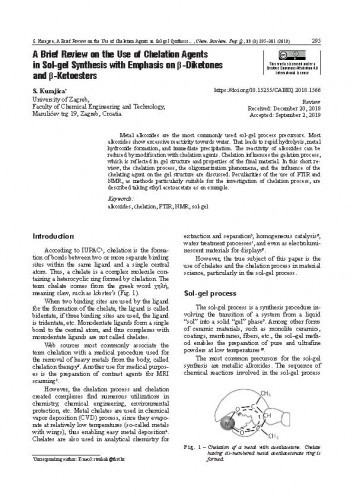
Metal alkoxides are the most commonly used sol-gel process precursors. Most alkoxides show excessive reactivity towards water. That leads to rapid hydrolysis, metal hydroxide formation, and immediate precipitation. The reactivity of alkoxides can be reduced by modification with chelation agents. Chelation influences the gelation process, which is reflected in gel structure and properties of the final material. In this short review, the chelation process, the oligomerization phenomena, and the influence of the chelating agent on the gel structure are discussed. Peculiarities of the use of FTIR and NMR, as methods particularly suitable for the investigation of chelation process, are described taking ethyl acetoacetate as an example.
Dio od
 Chemical & biochemical engineering quarterly : the international publication of "Kemija u industriji" : the official journal of Croatian Society of Chemical Engineers, Faculty of Chemical Engineering and Technology University of Zagreb, Slovenian Chemical Society, and Austrian Association of Bioprocess Technology : 33,3(2019) / Co-Editors-in Chief: M. Rogošić, B. Zelić.